
The Complanari di Roma flank and extend one of the most important traffic hubs of the Italian capital, the A24 Urban Penetration Trunk, familiarly nicknamed “il tronchetto” by the Romans.
It is the only urban highway that penetrates the historic heart of the Eternal City, crossing the tracks of the Tiburtina station to end close to the perimeter wall of the Monumental Cemetery of Verano, at the junction with the Tangenziale Est. Every morning during rush hour, over 30 thousand cars pass through this artery in less than three hours. This is where the traffic flow of commuters who work in the center of the Italian capital and who use the A24 and A25 highways is concentrated.
Thanks to the convenient link with the A1 Milan-Naples highway, a good part of the vehicles coming from Florence and Naples and headed to the center of Rome also pass through here. Through the interconnection junction with the Grande Raccordo Anulare, this stretch of motorway is also able to provide a rapid connection with Rome’s two airports, Fiumicino and Ciampino. It is here that 130 thousand vehicles pass every day.
In April 2014, Strada dei Parchi completed work on the construction of the Complanari to the A24, between the Viale P. Togliatti junction and the Barriera di Roma Est. An effective and decisive improvement, awaited for years, which has significantly improved access to the city of Rome, redistributing local and long-distance traffic on four wide double-lane carriageways.
The addition of two parallel roads, an additional carriageway for each direction of travel, has allowed for an increase in transport capacity in both directions (in and out of Rome), reducing travel times, promoting greater flow speed and a reduction in the accident rate, resulting from the improvement in safety standards.

An innovative reconfiguration of the junction with the Grande Raccordo Anulare (the so-called “GRA node”) has allowed traffic to flow more fluidly at the point of greatest concentration, where there has always been a massive flow, coming from and going to every area of the Capital.
The improvement of the infrastructure was achieved thanks to:
- the addition of two parallel urban roads for a total extension of approximately 22 km
- the construction of new overpasses and ramps for a total of 4 km
- the upgrading of restraint systems and signs for approximately 14 km
- the installation of new safety barriers for a total of 67 km
- the installation of sound-absorbing panels and a new draining and sound-absorbing pavement
- the reconfiguration of the junction with the GRA with the insertion of two new macro-ramps in place of the old and ineffective “cloverleaf” configuration
- the creation of a third lane, both in the direction of Rome and in the direction of L’Aquila, between the Portonaccio junction and the Cervelletta viaduct.
The construction site
With a development of over 14 km, the construction site for the construction of the Complanari di Roma was among the most complex and important activated in Italy in the last 20 years and among the most delicate, due to its proximity to the most populous metropolitan area in Italy. The works had a record duration of only 35 months instead of the 37 planned and were almost all carried out off the motorway carriageway.
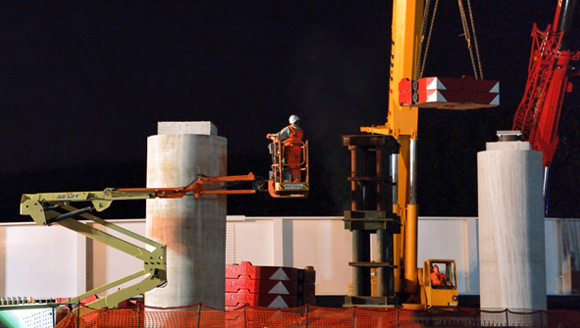
All the activities that had a high impact on traffic, with the closure of the motorway to traffic, were planned and carried out at night. During all phases of the works, two lanes were always guaranteed for each direction of travel.


