
Why a series dedicated to the castles and fortresses that dot the regions between Lazio and Abruzzo? The most immediate answer is that many of these fascinating structures are clearly visible from the A24 and A25 highways, accompanying them along their entire route. But the deeper reason is another: fortifications and manors are among the most powerful symbols of identity in these lands, places that for centuries have served as borders, frontiers, and junctions. Here, Swabians and Angevins, Aragonese and conspiring feudal lords have clashed; here, armies from beyond the Alps, Saracen raiders and Ottoman pirates have entered, and great captains of fortune have clashed; here, sheep tracks, flocks, merchants, and cultures have passed, making these territories a fruitful bridge between the large-estated southern Italy and the prosperous municipal economies of Central Italy. Castles have defended, watched over, but also welcomed: they have been military garrisons, centers of economic exchange, small Renaissance courts, places of delight, and today, in many cases, they remain vibrant cultural spaces, animated by events, museums, and film productions. With this series, in the year of L’Aquila as Italian Capital of Culture, we want to take you on a journey that is both historical and touristic, exploring the beauty and identity of a region we are privileged to travel through and connect every day. A journey that will also accompany you on the highways, with dedicated graphics in some service areas.
But let’s start with a very significant date, March 20th…
The Civitella del Tronto Fortress, built by order of Charles of Anjou on March 25, 1269, and completely renovated starting in the mid-16th century by order of Philip II of Spain, is emblematic: the site of famous sieges—from the 1557 siege against the French troops of the Duke of Guise to the Napoleonic sieges of 1799 and 1806—it has endured centuries of conflict between Italy’s most coveted kingdom and the great European dynasties.
Even in the 20th century, during the Second World War, Civitella del Tronto was the scene of a shining example of civil solidarity in the darkest moment of recent history, with the assistance provided by the population to the Jews interned in the local concentration camp, an event that earned the Municipality the Bronze Medal of Civil Merit. However, there is a date that makes Civitella del Tronto a symbolic place in national history: March 20, 1861.
March 20, 1861: the last surrender, three days after the rest of Italy
On that morning 165 years ago, after approximately two hundred days of siege, at 11:00 a.m., Major Giovanni Raffaele Tiscar raised the white flag on the Fortress, marking the surrender of the last garrison of the Kingdom of the Two Sicilies, three days after the proclamation of the Kingdom of Italy in Turin on March 17th and the fall of Gaeta on February 13th of the same year. Civitella del Tronto was the last Bourbon stronghold to surrender, the last vestige of a kingdom now defeated but not yet resigned. A resistance that official history has long simplified, but which continues to challenge and divide memories. Today, this village, included in the circuit of the Most Beautiful Villages in Italy, preserves this complex legacy without turning it into a relic: the Bourbon monarchy, the Savoy monarchy, and the Republic are still intertwined in stories, celebrations, and even in the cuisine, where dishes like Filetto alla Borbonica or Spezzatino alla Franceschiello convey, through their flavors, a fragment of shared history.
A fortress to experience: numbers, records, and useful information for your visit
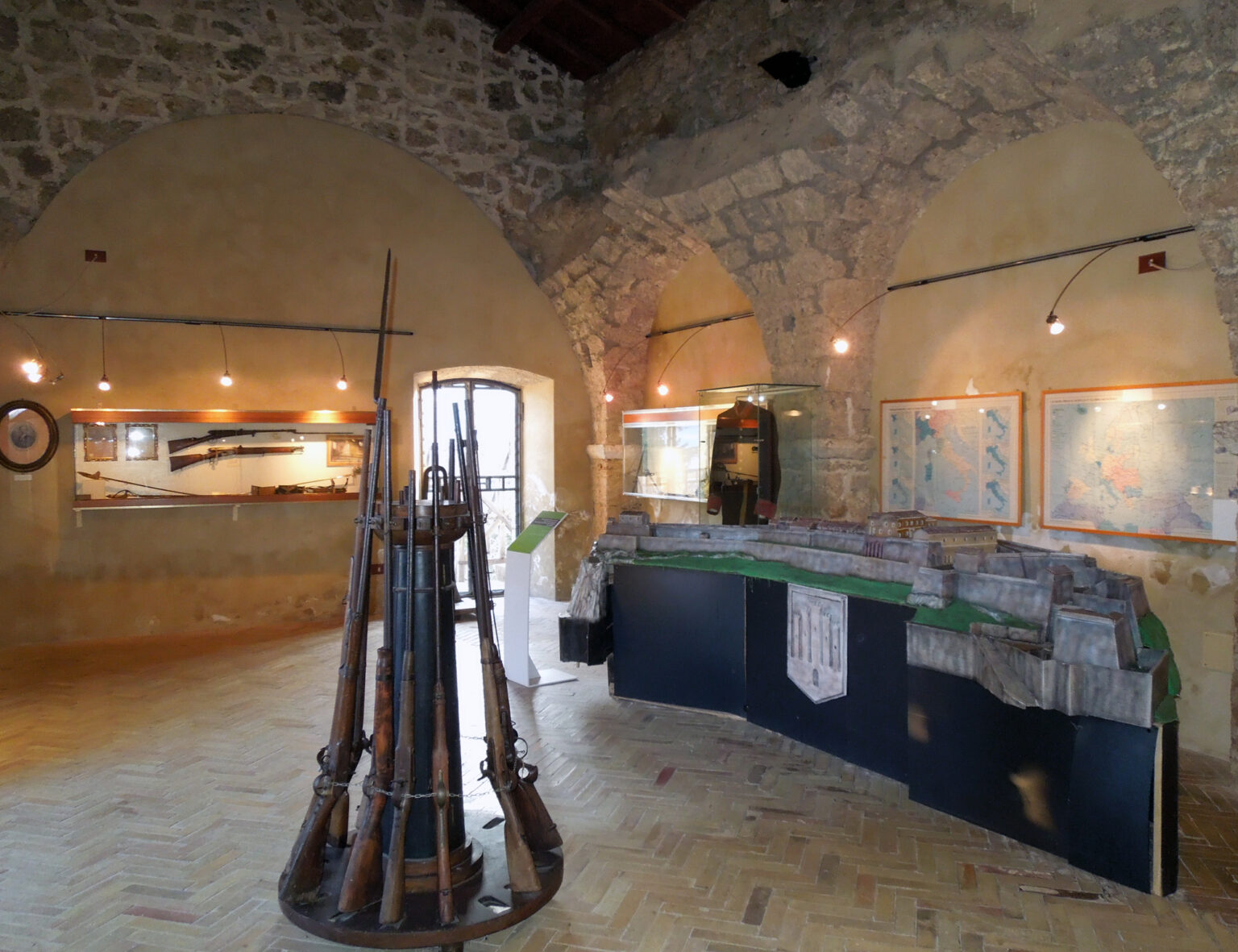
Visiting Civitella del Tronto today means entering one of the most impressive works of military engineering in Europe. The Fortress is over 500 meters long, with a surface area of approximately 25,000 square meters, and is considered the largest Spanish fortress in Italy. Perched approximately 600 meters above sea level, it dominates the Val Vibrata and offers a view that ranges from the Monti della Laga and Gran Sasso to the Adriatic Sea. The tour route passes through covered walkways, parade grounds, cisterns, and patrol paths, and houses the Museum of Weapons and Ancient Maps. The Fortress can be visited year-round with seasonal opening hours (approximately 10:00 am to 5:00 pm in the winter months, until 8:00 pm in the summer, with last admission 30 minutes before closing). The picturesque village of Civitella del Tronto, at the foot of the fortress, is characteristic and full of curiosities. Among its narrow streets, you can stumble upon the Ruetta, considered the narrowest alley in Italy. A medieval passageway that in some places is barely 40 centimeters wide.
Reaching this destination is also easy from the highway: from the A24 Rome–Teramo, you can exit at the Teramo Ovest toll booth, continuing along the Val Vibrata along the ordinary road to Civitella del Tronto, on an itinerary that in just a few kilometers leads from modern infrastructure to a place where history becomes landscape. An invitation to slow down, exit the highway, and discover up close a heritage that continues to tell who we are.